
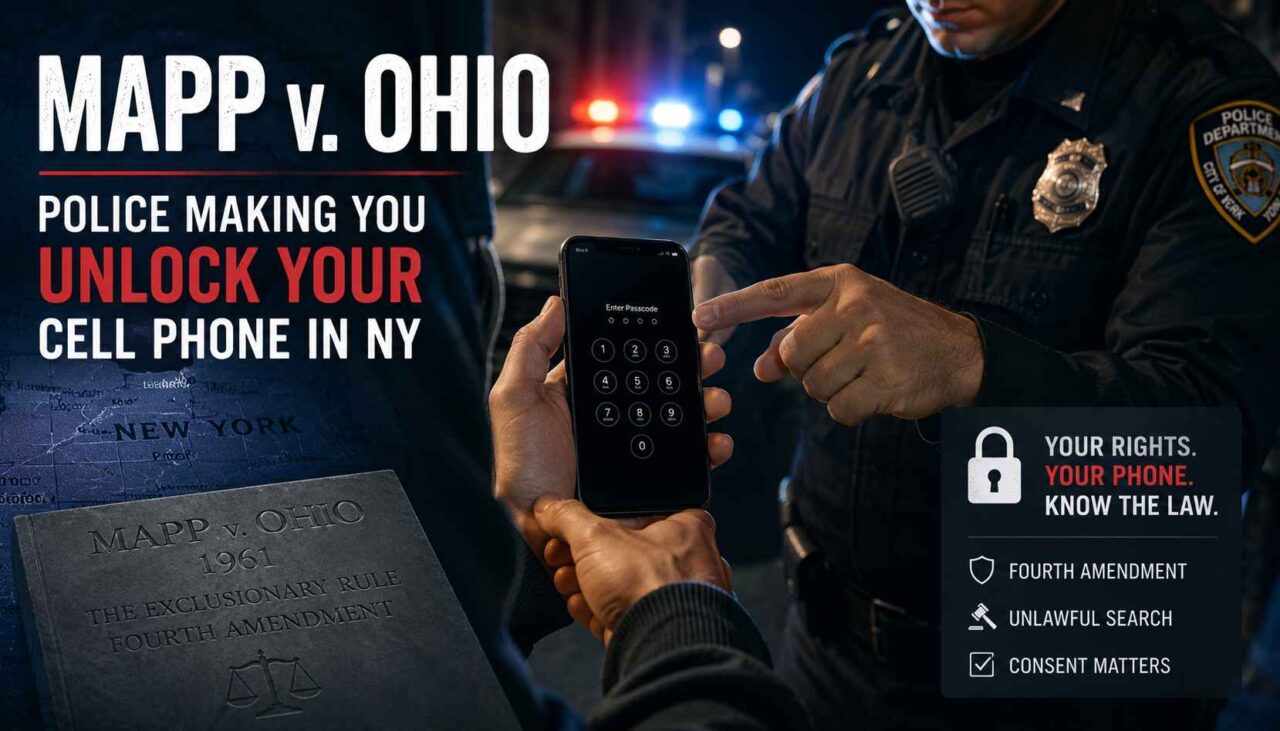
Can police make you unlock your phone during a traffic stop or a stop-and-frisk? And by “make,” I do not just mean physical force, such as pressing your thumb onto the sensor or holding the phone up to your face. I also mean the more common version: confusing, forceful, or intimidating language designed to make you believe you have no choice. Some call that “verbal judo.” I call it pressure.
In Part 1, I talked about traffic stops, police questions, consent to search, and the importance of keeping your cool when an ordinary drive turns into a law enforcement encounter.
Now let’s talk about the object most people carry everywhere, touch hundreds of times a day, and protect with more concern than their wallet: the cellphone.
Your phone is not just a phone anymore. It is your bank. Your calendar. Your family album. Your text history. Your email. Your social media. Your private conversations. Your location history. Your work life. Your bad decisions. Your better decisions. Your life, conveniently wrapped in glass and carried in your pocket.
So what happens when a police officer asks you to unlock it?
That question may come up during a traffic stop. It may come up during a stop-and-frisk encounter on the street. It may come up after an arrest. It may sound casual.
“Can you open your phone for me?”
“What’s the passcode?”
“Just unlock it so we can clear this up.”
That last phrase is dangerous because it sounds helpful. It suggests that if you cooperate, the whole thing may go away. Maybe it will. Maybe it will not. But once your phone is unlocked and police begin looking through it, the situation may become much larger than whatever started the encounter.
This is where the Constitution still matters.
Mapp vs. Ohio and the Reason Illegal Searches Matter
Before talking about phones, we need to return to one of the most important search-and-seizure cases in American criminal law: Mapp v. Ohio.
Mapp v. Ohio is the case that made the exclusionary rule apply to the states. In plain English, that means evidence obtained through an unconstitutional search generally cannot be used by prosecutors in a criminal case.
That rule matters because rights without consequences are not really rights. If police could violate the Fourth Amendment and prosecutors could still use whatever was found, the protection would be mostly decorative. Nice language. No teeth.
The exclusionary rule gives the Fourth Amendment teeth.
It does not mean every police mistake gets a case dismissed. It does not mean every bad search destroys the prosecution. The law is more complicated than that. But it does mean that when police unlawfully search a person, car, home, bag, or digital device, the defense lawyer may have a basis to challenge the evidence.
And with cellphones, that issue becomes even more serious.
Your Phone Is Not the Same as Your Pocket
There was a time when a search incident to arrest meant police could look through physical items found on a person. A wallet. A cigarette pack. A small container. The logic was officer safety and preservation of evidence.
But a smartphone is different… A cellphone can contain years of private information. One device may reveal where you have been, who you communicate with, what photos you saved, what websites you visited, what you searched, what apps you use, what doctors you emailed, what lawyers you contacted, what you bought, and what you deleted.
In Riley v. California, the United States Supreme Court recognized that modern cellphones are not ordinary physical objects. The Court held that police generally need a warrant before searching digital information on a cellphone seized from someone who has been arrested.
That is a major protection. It means the police usually cannot say, “We arrested you, so now we get to scroll through your entire digital life.” A lawful arrest may allow police to seize the phone. It does not automatically allow them to search the contents.
There is a difference between taking the phone and getting inside the phone.
Can Police Ask You to Unlock Your Phone?
Yes. Police can ask… Anyone can “ask” you anything. That is the part people often miss. Police are allowed to ask many questions. They may ask where you are going. They may ask what is in the car. They may ask whether you have been drinking. They may ask to search your bag. They may ask to look in your phone.
The better question is whether you have to agree.
In many situations, the answer is no. You do not have to voluntarily unlock your phone just because an officer asks. You do not have to provide your passcode just because the request is phrased politely. You do not have to help police search your digital life because they say, “This will only take a second.”
That “second” may become the foundation of a criminal case.
A Simple Response
If an officer asks to search or unlock your phone, a calm response may be:
“Officer, I do not consent to a search of my phone.”
If the officer asks for your passcode, you may say:
“I am not providing my passcode. I want to speak with an attorney.”
Do not yell. Do not debate. Do not start explaining what is on the phone. Do not say, “There is nothing bad on there,” because now you are talking about the contents of the phone.
The goal is not to convince the officer. The goal is to preserve your rights.
Passcodes, Face ID, and Fingerprints Are Not All the Same
This is where the law gets more complicated.
A passcode comes from your mind. It is knowledge. Asking you to reveal it may raise Fifth Amendment concerns because the government may be trying to force you to communicate information that could incriminate you.
A fingerprint or facial recognition scan may be treated differently by some courts because it involves a physical characteristic. Courts across the country have not been perfectly uniform on this issue, and the law continues to develop as technology changes.
That means you should not assume the rules are simple. You should not assume that every TikTok lawyer, podcast expert, or cousin who once beat a parking ticket understands the difference between a warrant, consent, a passcode, biometrics, the Fourth Amendment, and the Fifth Amendment.
In real criminal cases, details matter.
Did the police have a warrant? What did the warrant authorize? Did they compel the unlock? Did they ask for consent? Did the person voluntarily hand over the phone? Was the phone searched at the scene or later? Was the person in custody? Were Miranda issues involved? Was there a stop-and-frisk? A car stop? An arrest? A probation or parole condition?
Small facts can change the legal analysis.
Traffic Stops and Phone Searches
During a traffic stop, police may ask questions. They may ask for license, registration, and insurance. Depending on the circumstances, they may ask you to step out of the car. They may investigate the reason for the stop and related safety concerns.
But a traffic stop does not automatically give police permission to search your cellphone.
If an officer says, “Unlock your phone,” the safest response is not a speech. It is not a constitutional lecture. It is not, “I know my rights,” followed by three minutes of roadside law school.
A better response is short: “I do not consent to a search of my phone.”
If you are being detained, you can also ask: “Officer, am I being detained, or am I free to leave?”
If you are arrested: “I wish to remain silent. I want an attorney.”
Then stop talking. Stop… Talking…
The more you explain, the more material you create. The more material you create, the more your lawyer may have to clean up later.
Stop-and-Frisk Is Not a Free Pass to Search Your Phone
A stop-and-frisk encounter is different from a traffic stop, but the same basic idea applies: the police do not get unlimited access to your private life because they stopped you on the street.
In New York City, stop-and-frisk has a long and complicated history. An officer may stop someone when there is reasonable suspicion of criminal activity. A frisk is generally about officer safety and weapons, not general rummaging for evidence.
That distinction matters.
A frisk is not supposed to be a fishing expedition. It is not supposed to become, “Let me scroll through your messages.” A pat-down of outer clothing for weapons is not the same thing as searching the contents of a smartphone.
If an officer asks you to unlock your phone during a street encounter, you can calmly refuse consent.
“I do not consent to a search of my phone.”
If the officer continues asking questions: “I prefer not to answer questions.”
If the situation escalates: “I want to speak with an attorney.”
Again, there is no need to perform. No need to argue. No need to make the officer like you. Your job is to stay safe and protect the legal issue.
What If Police Take the Phone Anyway?
Police may seize a phone under certain circumstances. That does not necessarily mean they can search it.
This is an important distinction.
Seizing the phone means taking possession of it. Searching the phone means accessing and reviewing the digital contents. The Fourth Amendment analysis may be different for each step.
If police take your phone, do not physically resist. Say clearly:
“I do not consent to any search of my phone.”
If they search it anyway, that may become an issue for court. Your lawyer can examine whether there was a warrant, whether the warrant was valid, whether the search exceeded the warrant, whether consent was claimed, whether the phone was lawfully seized, and whether the evidence should be suppressed.
That is where Mapp v. Ohio comes back into the picture.
The courtroom is where unlawful searches can be challenged. The street is where people often make things worse.
Consent Is Often the Government’s Favorite Word
In many search cases, the prosecution does not need to prove that the police had the perfect legal theory if they can argue that the person consented.
That is why consent matters so much.
If you unlock your phone and hand it over, the government may later say you agreed. You may say you felt pressured. You may say you did not understand. You may say you thought you had no choice. Those arguments may matter, but they are harder than simply having said, clearly and calmly, that you did not consent.
Do not make the government’s job easier.
You do not need to be rude. You do not need to hide the phone. You do not need to run, resist, or act suspiciously. You simply need to make your position clear.
“I do not consent to a search of my phone.”
That sentence is not dramatic. It is not exciting. It will not go viral. Good. Viral is rarely helpful in criminal defense.
What About “If You Have Nothing to Hide”?
This phrase is one of the most effective pressure tactics in law enforcement encounters.
“If you have nothing to hide, why not just unlock it?”
Here is the answer: because privacy is not proof of guilt.
People have private information on their phones because they are human beings. Medical information. Family messages. Financial records. Photos. Work emails. Conversations with spouses, friends, children, lawyers, doctors, clergy, therapists, and people they had no business texting at 1:14 in the morning.
Privacy is not suspicious. Privacy is normal.
The Constitution does not protect only the innocent. It protects everyone. That is the point.
If the government has a lawful basis to search your phone, there is a process for that. The process usually involves a warrant, judicial review, and limits on what may be searched. That process exists because the phone in your pocket may contain more information about you than your house did twenty-five years ago.
Do Not Delete, Destroy, or “Clean Up” the Phone
Refusing consent is one thing. Destroying evidence is another.
Do not delete messages. Do not throw the phone. Do not factory reset it. Do not tell someone else to wipe it. Do not post online about what happened. Do not start sending “delete everything” texts to your friends.
That kind of behavior can create new legal problems.
Protecting your rights means staying silent, refusing consent, and calling a lawyer. It does not mean tampering with evidence or acting like the star of a low-budget crime movie who makes every possible wrong decision before the first commercial break.
Charged After a Phone Search in Queens or New York City?
Cellphone searches can change the direction of a criminal case. A traffic stop may become a drug case. A street stop may become a gun case. A DWI arrest may become something broader because of messages, photos, location data, or social media evidence.
But the fact that police found something on a phone does not end the analysis.
How did they get the phone? Did they have consent? Was there a warrant? Was the warrant too broad? Did the search go beyond what was authorized? Was the phone unlocked voluntarily or under pressure? Were statements made? Was the stop lawful in the first place?
These are not technicalities. These are constitutional questions.
As a Queens criminal defense lawyer and former prosecutor, I look closely at the beginning of the police encounter, the legality of the stop, the seizure of the phone, the search process, any claimed consent, and whether evidence may be challenged under the Fourth Amendment, the Fifth Amendment, or New York law.
If police searched your phone after a traffic stop, stop-and-frisk encounter, or arrest in Queens, Kew Gardens, Long Island, or anywhere in New York City, do not assume the case is over because they found something. The government still has to prove its case legally.
Your phone may hold your life. That does not mean the government gets to walk through it without a fight.
The Law Offices of Jeffrey D. Cohen, P.C. defends people facing criminal charges in Queens and throughout New York.
The Law Offices of Jeffrey D. Cohen, our motto is, We Stand By You…
Call my office today, at (718) 275-5900.
