
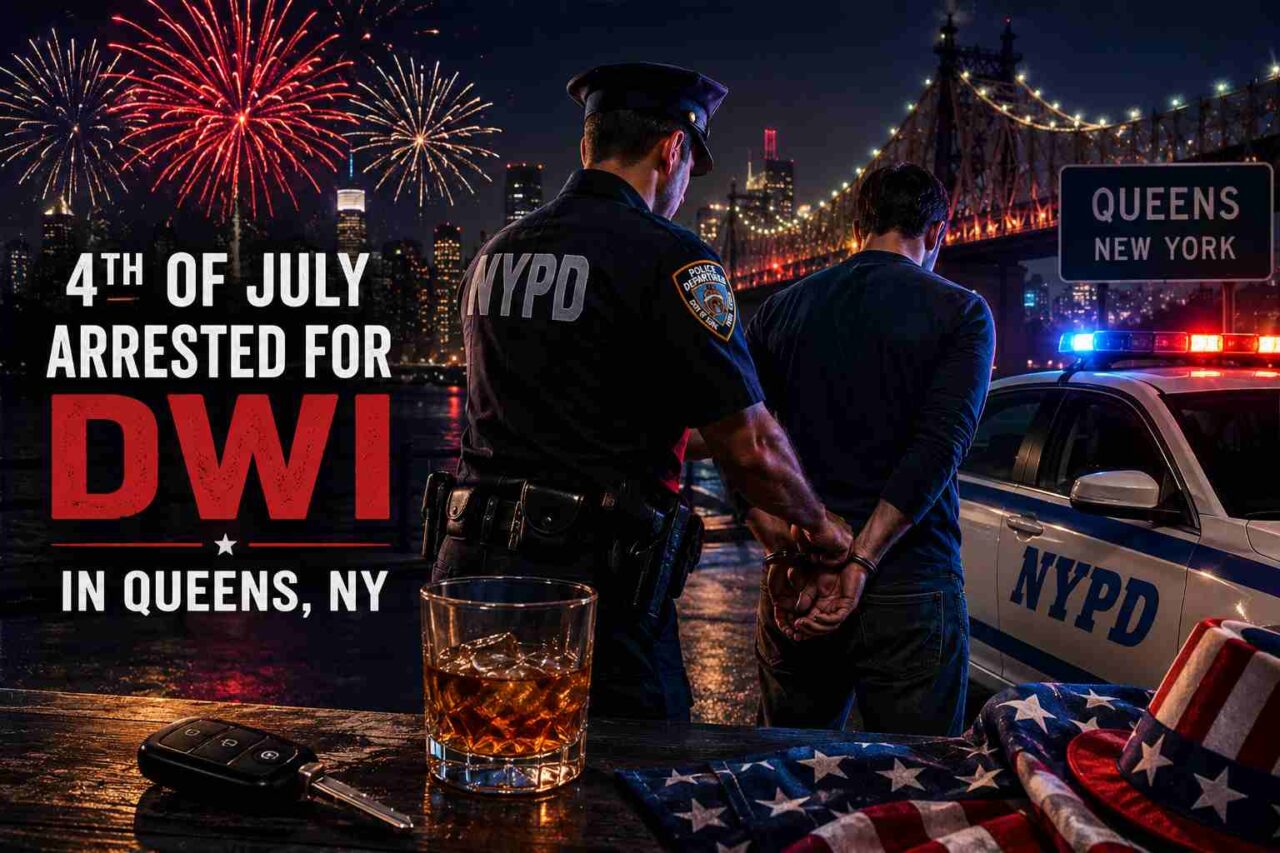
Fourth of July DWI Arrests in NY: Fireworks, Freedom, and Bad Decisions
The Fourth of July is supposed to be about freedom.
Freedom from work. Freedom to barbecue. Freedom to sit in traffic for two hours on the way to a party that started forty-five minutes ago. Freedom to watch fireworks, complain about the humidity, and pretend that one more hot dog is a reasonable decision.
It is not supposed to end with flashing lights in your rearview mirror.
But every year, around the Fourth of July, people make the same mistake. They think they are fine to drive. They had “only two beers.” They waited a little while. They drank water. They ate something. They feel normal enough. Then they pull onto the Grand Central, the Van Wyck, the Belt, the LIE, or a local road in Queens, and suddenly the holiday weekend takes a very different turn.
As a criminal defense lawyer in Queens, NY, I have represented people who never thought they would be arrested for DWI. They were not career criminals. They were not looking for trouble. They were regular people who made one bad decision at the wrong time, in the wrong place, with the wrong officer behind them.
That is how a celebration becomes a criminal case.
July Fourth Means More Police Are Looking for Impaired Drivers
Holiday weekends are not ordinary weekends for law enforcement. Police know people are traveling. They know people are going to parties. They know alcohol will be served. They know drivers may be on the road late, tired, distracted, impatient, or impaired.
So they look… That may mean increased patrols. It may mean checkpoints. It may mean more officers watching for signs of impaired driving near highways, bridges, beach routes, restaurants, bars, parks, and event areas. Around the Fourth of July, a small driving mistake that might not normally get much attention can become the beginning of a DWI investigation.
Weaving within a lane. Touching the lane marker. Rolling through a stop sign. Driving too slowly. Braking strangely. Forgetting to signal. Making a wide turn. Sitting too long at a green light because you were checking directions.
Any of those things may give an officer a reason to take a closer look.
And once the officer approaches the car, the conversation begins.
“How Much Have You Had to Drink?”
This is the question many drivers answer badly.
The officer asks, “How much have you had to drink tonight?”
The driver says, “Just two beers.” Maybe that is true. Maybe it is not. Maybe the driver thinks it sounds harmless. But from a legal perspective, that answer may not help. But legally, the officer can interpret that as, “I had two kegs of beer, while standing on my head”… Which could make him act on a Probable Cause that you just admitted to drinking heavily.
You have just admitted drinking before driving. Although, that does not automatically prove intoxication. It does not automatically mean you are guilty. But it gives the officer something to write down. It gives the prosecutor something to use. It gives the case a starting point that came directly from your mouth.
People often believe they can talk their way out of trouble. Sometimes they can. More often, they talk their way into evidence.
Helpful Is Not Always Helpful
A DWI stop is not the place to explain your evening.
You do not need to describe where you were, who you were with, how long you were there, what you drank, when you stopped drinking, whether you ate, whether you feel fine, whether you are tired, or whether you “know your limit.”
Most people who are arrested for DWI were trying to sound reasonable. They were not trying to confess. They were not trying to create evidence. They were trying to be cooperative.
There is a difference between being cooperative and being conversational.
You should provide your license, registration, and proof of insurance. You should remain calm. You should not argue, threaten, run, or resist. But you are not required to volunteer a full narrative of your night.
A calm response may be: “I prefer not to answer questions.” That may feel awkward. Too bad. Awkward is better than explaining yourself into a criminal case.
DWI and DWAI Are Not the Same Thing
In New York, people often use “DWI” as a general phrase for drunk driving, but the law has different categories.
DWI, or Driving While Intoxicated, is generally the more serious alcohol-related charge. A driver may be charged based on a blood alcohol content of .08% or higher, or based on other evidence of intoxication.
DWAI, or Driving While Ability Impaired, is different. It can apply when the prosecution claims alcohol impaired the driver’s ability to operate a vehicle, even if the driver was not legally intoxicated under the DWI standard.
There are also drug-related impaired driving charges and combined alcohol-and-drug allegations.
The important point is this: you do not need to be falling-down drunk to face consequences. You do not need to be slurring like a movie character. You do not need to be driving on the sidewalk while singing the national anthem through a traffic cone.
A DWI or DWAI case may be built from smaller details: odor of alcohol, bloodshot eyes, statements, driving pattern, field sobriety tests, breath test results, bodycam footage, officer observations, and chemical test evidence.
That is why the beginning of the stop matters.
Field Sobriety Tests Are Not Party Games
During a DWI stop, an officer may ask you to step out of the car and perform field sobriety tests.
Walk and turn. One-leg stand. Follow the pen with your eyes. Stand here. Look there. Don’t start yet. Keep your arms at your sides. Count out loud. Don’t put your foot down.
It sounds simple until you are doing it on the side of a road, with cars passing, lights flashing, nerves rising, and an officer watching every movement.
These tests are not designed to make you look graceful. They are investigative tools. The officer is looking for clues of impairment.
Maybe you have a bad knee. Maybe you are overweight. Maybe you are exhausted. Maybe the pavement is uneven. Maybe you have anxiety. Maybe English is not your first language. Maybe you misunderstood the instruction. Maybe the officer’s report later makes it sound cleaner than it felt in the moment.
All of that may matter later.
Do Not Perform for the Camera
Many police encounters are recorded. That means your words, movements, tone, balance, attitude, and facial expressions may all become part of the case.
Do not try to be funny. Do not joke about drinking. Do not say, “I’m not drunk, I’m just bad at tests.” Do not ask the officer if he wants to try it after three beers. This is not the moment for comedy.
That is my job, and even I would save it for later.
Stay calm. Listen carefully. Do not volunteer information. If you are arrested, ask for a lawyer and stop talking.
Breath Tests: Roadside vs. Chemical Testing
Breath testing can be confusing because there may be more than one kind of test.
An officer may use a portable breath test during the roadside investigation. Later, after an arrest, there may be a chemical breath test at the precinct or testing location. The legal consequences of refusing, taking, or challenging these tests can be significant.
New York’s implied consent law can create serious license consequences if a driver refuses a chemical test after being lawfully arrested. At the same time, test results are not automatically the end of the case. Machines have procedures. Officers have protocols. Records matter. Timing matters. Calibration, observation periods, medical issues, and the facts of the stop may all become relevant.
The worst thing a person can do is treat the DWI process casually.
A DWI is not just a traffic ticket. It can affect your license, your job, your insurance, your immigration situation, your professional license, your record, and your ability to move through life without explaining one bad night again and again.
Sleeping It Off in the Car Can Still Become a Problem
Every Fourth of July weekend, someone thinks they found the responsible solution.
“I knew I shouldn’t drive, so I slept in the car.”
That sounds responsible. And sometimes, factually, it may help. But it does not automatically prevent a DWI arrest.
Were the keys in the ignition? Was the engine running? Was the car parked legally? Were you in the driver’s seat? Was the vehicle warm? Did someone see the car moving earlier? Did you make statements about driving? Was there an accident? Were there witnesses?
These facts matter.
If you are impaired and sitting in a car, do not assume you are legally safe simply because the car is not moving when police arrive. The better decision is to arrange a ride, use a car service, stay where you are, or make a plan before the first drink.
Yes, that sounds boring. So does keeping your license.
The Biggest Mistake After a DWI Arrest
Once someone is arrested, panic sets in.
They want to explain. They want to apologize. They want to say they are a good person. They want to tell the officer they have never been arrested before. They want to say they only drove because their friend was worse. They want to say they were close to home. They want to say this will ruin their life.
I understand the instinct. Resist it and do not do it.
If you are arrested, the safest words are: “I wish to remain silent. I want to speak with an attorney.”
Then stop talking.
- Not “stop talking, except for the part where you explain that you are not really drunk.”
- Not “stop talking, except for the part where you tell the officer you respect police.” Not “stop talking, except for the part where you ask whether this can be handled another way.”
Stop talking.
The government has the burden of proof. Do not help fulfill that burden.
A DWI Case Is Not Over Because You Were Arrested
Being arrested is not the same as being convicted.
In a DWI case, a defense lawyer may examine the legality of the stop, the officer’s observations, the basis for removing you from the car, the field sobriety tests, the chemical test, the timing of the test, the paperwork, the video, the warnings given, the refusal procedures, and the officer’s compliance with required protocols.
Sometimes the issue is the stop. Sometimes it is the test. Sometimes it is the way the evidence was gathered. Sometimes it is the difference between what the officer wrote and what the video shows.
Details matter… And in criminal defense, details are often where the fight begins.
Celebrate Freedom Without Needing a Lawyer by Midnight
The Fourth of July should end with fireworks, not fingerprints.
If you are going out, make a plan before you drink. Decide who is driving. Use a rideshare. Take a taxi. Stay with a friend. Walk if it is safe. Do anything reasonable that does not involve convincing yourself you are “probably fine.”
Because once the lights go on behind you, the evening is no longer about what you intended. It is about what the officer observes, what you say, what the test shows, and what the prosecutor believes can be proven.
Freedom is a wonderful thing. So is not spending the holiday weekend trying to remember whether you gave the officer your license before or after you said, “I only had two beers.”
Charged With a Fourth of July DWI in Queens or New York City?
A Fourth of July DWI arrest can turn a holiday weekend into something much more serious. The charge may affect your license, your record, your employment, your family, and your future. But the arrest is only the beginning of the legal process, not the end of it.
As a Queens criminal defense lawyer and former prosecutor, I look closely at what happened before, during, and after the stop. Why were you pulled over? What did the officer claim to observe? Were field sobriety tests properly administered? Was the breath test reliable? Were your rights respected? Did the government follow the rules?
Those questions matter… If a Fourth of July DWI arrest has turned into something more serious, call my office.
The Law Offices of Jeffrey D. Cohen, our motto is, We Stand By You…
Call my office today, at (718) 275-5900.
Save my number.
