
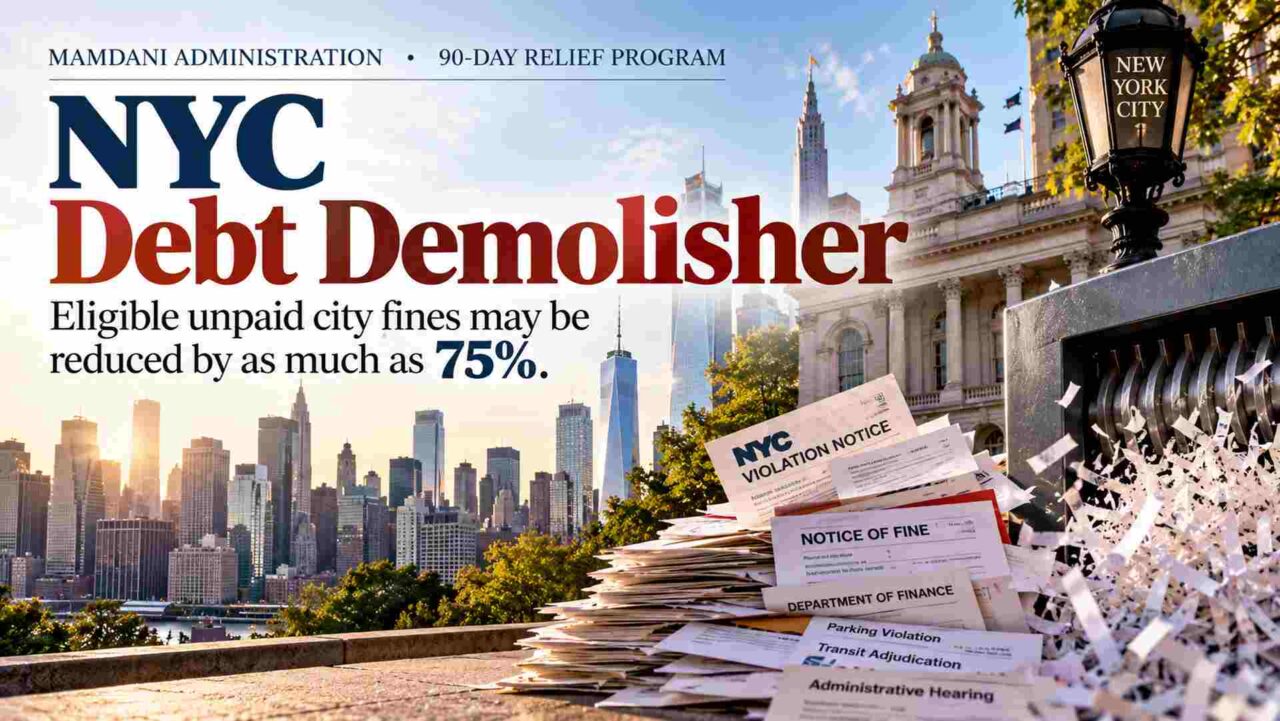
An amnesty program, in itself, is a great idea. The problem begins when the so-called Debt Demolisher amnesty program becomes less about resolving legitimate problems and more about political convenience. I have been practicing criminal defense law in Queens for a long time, and one thing I’ve learned is that people have a remarkable ability to justify almost anything when the rules no longer suit them. Politicians, apparently, are no exception.
On October 13, 2026, New York City Mayor Zohran Mamdani announced something called the Debt Demolisher program, a 90-day amnesty initiative allowing qualifying businesses and property owners to settle certain outstanding city fines at reduced amounts. Depending on the circumstances, accumulated interest and penalties can be waived, and some underlying fines can be reduced.
The administration says the program will help struggling New Yorkers while collecting approximately $25 million in outstanding fines that the city might otherwise never recover. That may be a perfectly reasonable financial objective. After all, collecting some money is generally better than collecting none.
But as I read through the announcement, something else occurred to me, and it had very little to do with the city’s projected revenue.
What about yesterday?
What about the business owner who paid his fine last week? The homeowner who dipped into savings to satisfy a city violation? The family that borrowed money, worked additional hours, or postponed something important because they believed an obligation was an obligation?
More importantly, what happens to a society when the consequences of following the rules increasingly depend on which politician happens to be in office, which program is being announced, and whether someone held out long enough to qualify for the next round of forgiveness?
These are not simply financial questions. They go directly to the credibility of our laws.
NYC Fine Amnesty Program: Yesterday’s Obligation, Today’s Discount
Under the city’s new amnesty program, certain outstanding judgments arising from Environmental Control Board violations can be resolved for less than the amounts previously owed. The program runs from October 13, 2026, through January 10, 2027.
For eligible judgments entered after someone failed to attend a hearing, the city may waive default penalties and accumulated interest while requiring payment of the original base fine. For qualifying judgments where someone attended a hearing and was found liable, the city may waive interest and reduce the imposed fine by 25%.
This is not a general cancellation of taxes, nor does it mean every outstanding city fine qualifies. There are eligibility restrictions, and some violations require corrective action in addition to payment.
Nevertheless, consider two hypothetical businesses operating a few blocks apart in Queens.
Both receive similar violations. Both are assessed fines. The first owner pays the amount owed, perhaps reluctantly, but pays it because ignoring a government obligation generally comes with consequences. The second owner leaves an eligible fine unpaid long enough for it to become an outstanding judgment.
Now the city introduces a program under which the second owner may settle for less.
I’m not suggesting the first owner is entitled to a refund. That isn’t my argument. Nor am I suggesting that everyone with an unpaid fine is irresponsible. People encounter genuine financial hardship, particularly small-business owners trying to survive in New York City.
My concern is with the incentive government creates when it repeatedly demonstrates that yesterday’s obligation may become tomorrow’s negotiable suggestion.
We tell people that complying with the law matters. We impose deadlines, penalties, interest, and consequences to reinforce that message. Then we periodically announce exceptions and celebrate the relief being offered.
There is an irony in congratulating government for rescuing people from financial consequences that government itself established. It’s an irony worth examining before we start printing the congratulatory banners.
When Debt Forgiveness Becomes a Political Promise
We’ve encountered versions of this argument before, most notably during President Joe Biden’s efforts to provide broad student loan forgiveness.
Consider the family that spent fifteen years paying off college debt. Perhaps the parents helped their children make payments. Perhaps someone worked two jobs, postponed purchasing a home, or sacrificed retirement contributions because the family believed borrowed money had to be repaid.
Then the federal government proposed canceling substantial student loan balances for qualifying borrowers.
I understand why borrowers carrying substantial student debt supported the proposal. I also understand why people who had already repaid their loans might have viewed it quite differently.
The Supreme Court addressed Biden’s broad cancellation plan in Biden v. Nebraska in June 2023. By a 6–3 decision, the Court held that the administration lacked authority under the HEROES Act to implement the proposed approximately $430 billion cancellation program.
The Court did not decide that all student loan forgiveness was unconstitutional, or that people who had already repaid their loans were entitled to equivalent compensation. The decision concerned the limits of executive authority under the statute being invoked.
That distinction matters because forgiveness programs raise at least two separate issues: whether the government has the legal authority to implement them, and whether exercising that authority is a sound public policy.
They are not necessarily the same question.
With Mamdani’s NYC fine forgiveness initiative, the administration has identified a practical objective: recovering outstanding revenue while reducing financial burdens. Supporters can reasonably point to those benefits.
Critics can also reasonably question whether programs of this kind, particularly when they become recurring features of government, influence how people respond to future obligations.
And politicians understand that announcing financial relief tends to attract more immediate attention than explaining the long-term consequences of how that relief is structured.
Whether any particular program is primarily driven by public policy, political advantage, or some combination requires evidence. But the possibility that short-term political incentives can influence the treatment of legal obligations deserves scrutiny.
What the Constitution Says About Changing the Rules
There is a constitutional dimension to this discussion, although perhaps not the one people initially imagine.
The Fourteenth Amendment’s Equal Protection Clause generally requires states and local governments to provide equal protection under the law. It does not, however, guarantee that everyone will experience identical financial consequences when the government changes a policy.
In FCC v. Beach Communications (1993), the United States Supreme Court explained that ordinary social and economic classifications generally survive constitutional review if a rational basis can support them.
In practical terms, government has considerable latitude to establish eligibility requirements, deadlines, exemptions, and financial relief programs.
A city may decide that reducing old fines will encourage collections. A legislature may change penalties. Congress may authorize certain forms of debt relief. The fact that somebody else paid more under an earlier set of rules doesn’t automatically make the new arrangement unconstitutional.
As a criminal defense attorney, I am particularly sensitive to the difference between what the government is legally permitted to do and what it ought to do.
The Constitution establishes limits on governmental power. It isn’t an insurance policy against every questionable public-policy decision.
Still, I find it troubling when the public is expected to regard legal obligations as firm and enforceable while accepting that the government may selectively relax them whenever a new policy becomes attractive.
Government discretion is necessary. But public confidence depends, at least in part, on believing that discretion is exercised consistently and for legitimate reasons.
What Happens When Yesterday’s Crime Becomes Legal Today?
The issue becomes considerably more complicated when we move from fines and financial obligations into criminal law.
Consider a man serving a sentence for possessing marijuana. He was arrested, prosecuted, convicted, and sentenced under the law that existed when he committed the offense.
Then the law changes… New York legalized possession of limited amounts of cannabis for adults on March 31, 2021. The legislation also provided for expungement of certain previous marijuana convictions and mechanisms for addressing some existing sentences.
Under New York Criminal Procedure Law Section 440.46-a, qualifying convictions for conduct that would no longer constitute a crime may be vacated, dismissed, and expunged. Other cannabis-related convictions may qualify for resentencing or additional relief.
As someone who represents people accused of criminal offenses, I recognize the importance of this distinction. If society determines that particular conduct should no longer be criminal, there are legitimate reasons to reconsider whether people should continue suffering criminal consequences for it.
But the example illustrates how profoundly a change in government policy can affect people whose conduct occurred under an earlier law.
On Friday, conduct may expose a person to criminal punishment. After a statutory change takes effect, the same conduct, under the same circumstances, may be lawful.
Unlike an ordinary financial amnesty, this involves liberty, criminal records, and the state’s authority to punish. It would be a mistake to pretend the two situations are legally identical.
Yet both raise questions about consistency, legislative judgment, and the consequences of changing established rules.
Not every criminal law reform is an exercise in political pandering. Some changes correct genuine injustices or reflect new evidence and evolving public judgments. Others may generate serious disagreements over public safety and accountability.
The responsibility of lawmakers is to distinguish between those considerations rather than allowing political popularity to substitute for careful judgment.
I’ve defended enough people over the years to know that consequences matter. So does fairness. The challenge is making certain that both remain part of the conversation when politicians begin promising relief.
When Exceptions Become the Expectation
Returning to Mamdani’s Debt Demolisher program, I don’t dispute that some New Yorkers may benefit substantially from the opportunity to resolve old fines. Nor do I dispute that the city may recover money it otherwise would have difficulty collecting.
My concern is what happens when similar exceptions become an increasingly familiar feature of government.
If businesses begin to anticipate periodic fine reductions, some may become less inclined to resolve obligations promptly. If borrowers believe future political administrations will eliminate certain debts, their expectations may change. If lawmakers routinely alter penalties without adequately considering how those changes affect enforcement, public confidence in the law may suffer.
None of those outcomes is inevitable, and one temporary amnesty program does not establish that they have occurred. But these are reasonable questions for policymakers to examine, particularly before presenting financial forgiveness as an uncomplicated victory.
We live in a political environment where promising relief can be considerably easier than explaining responsibility. The person receiving forgiveness sees an immediate benefit. The person who already fulfilled the obligation may see little reason to celebrate.
And the broader public must decide whether repeated exceptions strengthen government by making enforcement more practical or weaken it by encouraging people to anticipate the next exception.
I would prefer that our elected officials spend at least as much time explaining the long-term effects of these decisions as they spend announcing their immediate benefits.
After years of practicing criminal defense law in Queens, I have considerable respect for the principle that laws can and sometimes should change. Our legal system would be a very different place if legislatures could never reconsider an outdated statute or courts could never correct an injustice.
But there is a difference between thoughtful legal reform and treating established obligations as convenient instruments of political messaging.
The real issue isn’t how we compensate the person who paid yesterday. It is whether the government’s decisions today create a system in which people can reasonably understand the rules, rely on their consistent application, and believe that compliance still means something.
I don’t expect politicians to stop announcing programs that make voters happy. That would probably require an amendment to human nature rather than the Constitution. I do expect the law to be treated as something more substantial than a campaign promise.
And when the next politician announces that another obligation has been forgiven, another penalty eliminated, or another rule rewritten, I hope someone remembers to ask not only who benefits today, but what the decision means for everyone expected to follow the law tomorrow.
If a criminal charge or legal violation has turned into something more serious, call my office.
Jeffrey D. Cohen, ESQ
Criminal Defense Lawyer in Queens, NY
The Law Offices of Jeffrey D. Cohen — We Stand By You.
Call my office today, at (718) 275-5900
